
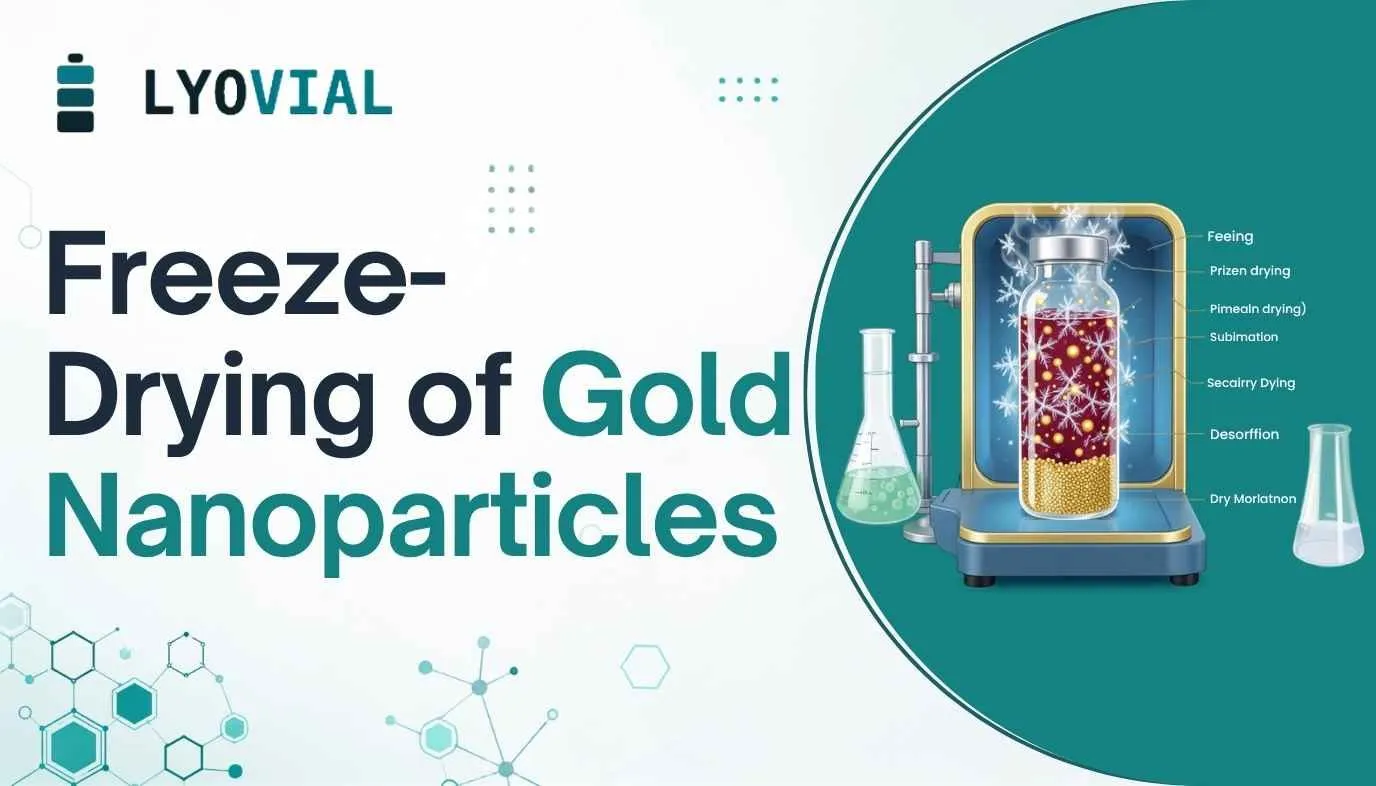
Executive Summary
Gold nanoparticles (AuNPs) are among the most widely used engineered nanomaterials, valued for their tunable localized surface plasmon resonance (LSPR), well-established surface chemistry, and biocompatibility. They underpin lateral-flow diagnostics, surface-enhanced Raman scattering (SERS) substrates, photothermal cancer therapeutics, targeted drug delivery, and reference materials for interlaboratory calibration. Nearly all of these applications depend on a colloidal suspension that has not aggregated — yet AuNP suspensions are intrinsically metastable, and irreversible aggregation during long-term liquid storage and shipping remains a persistent, largely unresolved problem.
Freezing and freeze-drying (lyophilization), borrowed directly from biopharmaceutical practice, offer a route to arrest particle motion and enable ambient- or refrigerated-temperature storage of AuNPs as a redispersible solid. The obstacle is that the freezing, drying, and reconstitution steps themselves generate the physical stresses — solute upconcentration, ice-crystal templated crowding, interfacial dehydration — that drive aggregation, so success depends entirely on selecting an effective cryoprotectant.
This white paper summarizes current evidence on cryoprotectant selection for AuNPs, anchored on Parnsubsakul et al. (2022, Colloids and Surfaces B), which systematically compared a sugar (sucrose), a surfactant (Tween 20), two polymers (PVA and PVP), and a biopolymer (pectin) for both freeze–thaw and freeze-drying of citrate-capped AuNPs. All five additives protected against freeze–thaw aggregation, but only sucrose, PVP, and pectin preserved redispersibility through full lyophilization; Tween 20 and PVA did not. The paper also raises a practical point often overlooked elsewhere in the literature: cryoprotectant residue left in the reconstituted suspension can itself interfere with downstream applications (bacterial-growth assays, particle-size measurement, bioconjugation, SERS), making a post-thaw washing step advisable. We integrate this study with the broader cryoprotectant literature — including gum arabic, dextran, trehalose/mannitol combinations, PEG-sugar mixtures, and 2024–2025 work on surface-coating strategies — into a single practical picture of what currently works, what does not, and why.
Table of Contents
1. Introduction
2. Why Gold Nanoparticles Aggregate
2.1 Colloidal Stabilization Mechanisms
2.2 Stresses Imposed by Freezing and Drying
3. Cryoprotectant Strategies: Two Complementary Approaches
3.1 Surface Passivation (Covalent/Thiolate Coatings)
3.2 Additive-Based Cryoprotection
4. Evidence from the Source Study (Parnsubsakul et al., 2022)
4.1 Experimental Design
4.2 Freeze–Thaw Performance
4.3 Freeze-Drying Performance
4.4 Post-Reconstitution Effects: Why Washing Matters
5. Cryoprotectant Classes in the Broader Literature
5.1 Sugars and Disaccharides
5.2 Polymers and Biopolymers
5.3 Surfactants and PEG
5.4 Combination Formulations
6. Practical Guidelines for AuNP Cryopreservation
7. Recent Developments (2023–2026)
8. Conclusions and Outlook
References
1. Introduction
Gold nanoparticles occupy a distinctive place among engineered nanomaterials. Their optical, electronic, and surface-chemical properties can be tuned through size, shape, and capping chemistry, giving rise to a strong, size- and shape-dependent localized surface plasmon resonance (LSPR) that underlies applications ranging from colorimetric reporter probes in lateral-flow assays, to SERS-active substrates for trace chemical detection, to photothermal nanoprobes for cancer therapy. Controllable, citrate-, ascorbate-, or tartrate-mediated reduction of Au(III) salts yields monodisperse particles with well-defined surface chemistry that is readily extended through gold–thiol (Au–S) conjugation, making AuNPs a standard reference material (e.g., NIST RM 8011) and a popular vehicle for targeted drug delivery.
The practical bottleneck across nearly all of these uses is long-term storage. AuNP suspensions are colloidally stable only as long as electrostatic or steric repulsion between particles overcomes van der Waals attraction; because smaller particles have proportionally higher surface energy, they are intrinsically prone to aggregate, and once aggregated, this process is essentially irreversible — the particles' plasmonic, catalytic, and conjugation properties are compromised. This is a serious constraint for distribution and shelf life across the biomedical and diagnostic supply chain.
Two broad strategies have been used to address AuNP instability. The first modifies the particle surface itself — grafting thiolated PEG, zwitterionic amphiphiles, or zwitterionic peptides to provide steric and hydration-shell protection — but this can compromise the surface real estate needed for later functionalization. The second, and the focus of this white paper, halts particle motion altogether by freezing or freeze-drying the suspension, following the well-established biopharmaceutical model used to stabilize proteins, antibodies, and cells. Because each step of a freezing or drying cycle imposes physical stresses capable of driving aggregation on its own, this route depends entirely on incorporating an effective cryoprotectant into the AuNP suspension before the process begins.
2. Why Gold Nanoparticles Aggregate
2.1 Colloidal Stabilization Mechanisms
Citrate-capped AuNPs (cit-AuNPs), the most common laboratory-synthesized form and the model system used in the source study, are stabilized electrostatically: citrate ions adsorbed on the gold surface impart a negative charge, and the resulting electrostatic double-layer repulsion keeps particles apart despite constant Brownian collision. This stabilization is intentionally weak and reversible by design (it allows further surface functionalization), which is precisely what makes cit-AuNPs so susceptible to the physical stresses of freezing.
2.2 Stresses Imposed by Freezing and Drying
As an AuNP suspension freezes, growing ice crystals exclude both solutes and nanoparticles from the advancing ice front, concentrating both into a shrinking pocket of unfrozen liquid. This freeze-concentration effect compresses the double layer, increases nanoparticle collision frequency by orders of magnitude relative to the dilute starting suspension, and screens the electrostatic repulsion that normally keeps particles apart — driving irreversible aggregation even in a suspension that was perfectly stable at room temperature. Subsequent drying (sublimation and desorption of water under vacuum) removes the hydration shell around both the particle surface and any adsorbed capping or protective molecules, further increasing the likelihood of direct particle–particle contact. Reconstitution can compound the problem if the redispersion medium does not restore the original electrostatic or steric protection quickly enough relative to any transient concentration gradients. In short, every stage of a freeze-drying cycle — freezing, primary/secondary drying, and rehydration — removes or disrupts the mechanism that ordinarily keeps AuNPs apart, unless a cryoprotectant substitutes for that protection during the process.
3. Cryoprotectant Strategies: Two Complementary Approaches
3.1 Surface Passivation (Covalent/Thiolate Coatings)
Grafting thiolated PEG, zwitterionic amphiphiles, or zwitterionic peptides directly onto the gold surface provides a permanent steric or hydration barrier that can, in the best cases, prevent freeze-drying-induced aggregation without any additional additive at all. Recent work (2025) on silica nanoparticles bearing analogous coatings found that PEG functionalization was the only tested surface chemistry that prevented freeze-drying-induced aggregation without a supplementary protectant, while zwitterionic, phosphonate, and amine coatings all still required an added cryoprotectant. The trade-off, noted repeatedly in the AuNP literature, is that a permanently grafted coating can block the very surface sites (thiol-reactive gold) needed for downstream bioconjugation, so this approach is best suited to applications where the particle surface chemistry is finalized before storage.
3.2 Additive-Based Cryoprotection
The alternative — and the approach evaluated in the source study — leaves the AuNP surface chemistry (e.g., citrate capping) untouched and instead adds a soluble protectant to the bulk suspension before freezing. This preserves maximum downstream flexibility for functionalization but requires the protectant to be removed (by washing/centrifugation) before certain applications, since residual protectant can interfere with assays performed on the reconstituted suspension. The remainder of this white paper focuses on this additive-based approach, which is by far the more thoroughly studied route in the literature.
4. Evidence from the Source Study (Parnsubsakul et al., 2022)
4.1 Experimental Design
Parnsubsakul and colleagues used citrate-capped AuNPs (mean diameter 16.82 ± 0.95 nm by TEM, LSPR absorption maximum at 518 nm) as a deliberately unstable model system, reasoning that a formulation effective for weakly stabilized cit-AuNPs would likely also protect more robustly capped particles. Five cryoprotectant candidates, spanning distinct chemical classes, were compared: sucrose (sugar), Tween 20/polysorbate 20 (surfactant), polyvinyl alcohol (PVA, ~90 kDa) and polyvinylpyrrolidone (PVP, ~360 kDa) (polymers), and pectin (biopolymer). Performance was assessed separately for (i) freeze–thaw cycling and (ii) full lyophilization, using UV–vis LSPR spectroscopy as the primary readout of aggregation state, since particle aggregation broadens and red-shifts the plasmon band in a readily quantifiable way.
4.2 Freeze–Thaw Performance
Every one of the five candidates — sucrose, Tween 20, PVA, PVP, and pectin — fully prevented irreversible aggregation of cit-AuNPs across freeze–thaw cycling, as judged by preservation of the original LSPR band shape and position after thawing. This indicates that, at least for freeze–thaw alone, a comparatively broad range of chemistries can substitute for the native citrate double layer during ice formation.
4.3 Freeze-Drying Performance
The picture changed markedly once the frozen suspensions were carried through full lyophilization. Sucrose, PVP, and pectin all maintained redispersibility of the dried cake, reconstituting to give AuNP suspensions with LSPR characteristics close to the pre-drying suspension. Tween 20 and PVA, by contrast, were not adequate cryoprotectants for the drying step — despite performing well during freeze–thaw alone — and are consequently better suited to protecting AuNPs solely through freezing/thawing (a role more consistent with their established use in protein cryopreservation) than to full freeze-drying. This freeze–thaw-versus-lyophilization divergence is the central practical finding of the study: a cryoprotectant validated only against freeze–thaw cycling cannot be assumed to work for freeze-drying, because the additional stresses of sublimation and secondary drying are qualitatively more severe.
4.4 Post-Reconstitution Effects: Why Washing Matters
A distinctive contribution of this study is its focus on what happens after successful reconstitution — a step largely unaddressed in earlier cryoprotectant literature. Using a Luria–Bertani (LB) agar plate assay, dynamic light scattering (DLS), and transmission electron microscopy (TEM), the authors showed that residual cryoprotectant left in the reconstituted AuNP suspension can measurably affect downstream use: for example, sugar or polymer residues can alter apparent particle size by DLS, appear in TEM micrographs, or influence bacterial growth assays conducted with the reconstituted suspension. The practical implication is that running a reconstituted AuNP suspension directly into a sensitive downstream application — ligand functionalization, protein conjugation, or use as a SERS substrate — without first washing out the cryoprotectant (typically by centrifugal washing) risks confounding or inaccurate results. The authors therefore recommend a standard workflow of synthesis → cryoprotectant addition → freezing/lyophilization → reconstitution → washing → application, rather than treating reconstitution as the final step.
Table 1. Cryoprotectant performance for citrate-capped AuNPs (Parnsubsakul et al., 2022)
| Class | Example(s) | Freezing (freeze–thaw) | Freeze-drying (lyophilization) |
| Sugar | Sucrose | Effective — prevented irreversible aggregation | Effective — redispersible cake |
| Surfactant | Tween 20 (polysorbate 20) | Effective | Poor — not recommended |
| Polymer | Polyvinyl alcohol (PVA, ~90 kDa) | Effective | Poor — not recommended |
| Polymer | Polyvinylpyrrolidone (PVP, ~360 kDa) | Effective | Effective — redispersible cake |
| Biopolymer | Pectin | Effective | Effective — redispersible cake |
Data summarized from Parnsubsakul, A., et al. (2022). Colloids and Surfaces B: Biointerfaces, 217, 112702.
5. Cryoprotectant Classes in the Broader Literature
The source study sits within a wider body of work on AuNP cryoprotection stretching back to at least 2014. Table 2 summarizes representative findings; the discussion below groups them by chemical class.
5.1 Sugars and Disaccharides
Sugars are the most consistently effective and most extensively validated AuNP cryoprotectant class. Alkilany et al. (2014), in one of the earliest systematic studies, ranked cryoprotectant efficacy for citrate- and mercaptoacetic-acid-capped AuNPs as trehalose ≈ sucrose > sorbitol > mannitol, and linked effectiveness to each molecule's chemical structure and its measured interaction with the nanoparticle surface (assessed by zeta potential). The proposed mechanism mirrors that established for sugar-based protein and cell lyoprotection: sugars form a rigid amorphous (vitrified) glass around the particle during drying and can hydrogen-bond to surface moieties, both of which restrict particle mobility and substitute for the lost hydration shell. Hamaly et al. (2018), working with antibody-conjugated gold nanorods, found trehalose gave the best colloidal stability of the nanorods themselves, while mannitol produced the best physical cake (shape and structural integrity), and that a trehalose/mannitol combination gave the best overall outcome — an early illustration that colloidal protection and cake quality can be optimized by different, complementary excipients within the same formulation, echoing the sugar-plus-macromolecule logic used in protein lyophilization.
5.2 Polymers and Biopolymers
Polymeric protectants (PVP, dextran, gum arabic, pectin) generally act by forming a viscous or glassy matrix that physically immobilizes individual particles during freeze-concentration and drying, analogous to their role in macromolecule-assisted cell lyoprotection. Kadowaki et al. (2021) screened a broad panel of additives for freeze–thaw protection of AuNPs and found dextran and PVP inhibited aggregation even at strikingly low concentrations (2 µg/mL). A follow-up study (Kadowaki et al., 2022) extended the screen to full freeze-thawing and freeze-drying and identified gum arabic as an outstanding performer: at only 20 µg/mL, gum arabic almost completely inhibited AuNP aggregation through both freezing and drying, outperforming PVP (the next-best additive, which still showed ~20% aggregation on freeze-drying at higher concentration). Mechanistic (FTIR/SEIRAS) analysis in that study indicated that gum arabic does not strongly adsorb onto the gold surface itself; rather, freeze-drying a gum arabic solution produces a rigid amorphous matrix with sufficient affinity for the gold surface that individual AuNPs become physically separated and immobilized within it — a matrix-entrapment mechanism distinct from surface passivation. Jauregui-Gomez et al. (2017) showed that pectin, when mixed into freshly prepared AuNPs immediately after synthesis, could similarly prevent agglomeration through freeze-drying, consistent with the pectin results in the source study.
5.3 Surfactants and PEG
Non-ionic surfactants such as Tween 20 can adsorb at the particle–water interface and provide steric stabilization sufficient for freeze–thaw protection, consistent with their established role in protein cryopreservation (where they mainly suppress interfacial denaturation), but the source study's finding that Tween 20 fails during full lyophilization suggests that simple interfacial adsorption is not, by itself, sufficient to survive the additional stress of sublimation and secondary drying. PEG-based strategies have generally performed better when covalently or strongly physisorbed onto the particle rather than added as a free surfactant: Wang et al. (2020) showed that a cyclic PEG (SEC16) combined with a small amount of sugar gave markedly better AuNP redispersibility after freeze-drying than either component alone, and 2025 work on silica nanoparticles found that permanently grafted PEG coatings could prevent freeze-drying aggregation without any additional protectant — reinforcing the surface-passivation route described in Section 3.1 as a genuine alternative to additive-based protection when compatible with the intended application.
5.4 Combination Formulations
A recurring theme across the more recent literature is that combining two protectant classes — a sugar with a polymer, or a physisorbed PEG with a sugar — tends to outperform either component alone, closely paralleling the sugar-plus-macromolecule strategy established for freeze-drying proteins and cells (see the companion white paper on cell preservation). This likely reflects complementary mechanisms: sugars provide close-range hydrogen bonding and vitrification at the particle surface, while polymers or PEG chains provide longer-range steric bulk and a higher glass-transition temperature for the surrounding matrix, together addressing both particle-level and cake-level failure modes.
Table 2. Representative cryoprotectant systems for AuNPs across the literature
| Study | AuNP system | Best-performing protectant(s) | Approx. effective dose |
| Alkilany et al., 2014 | Citrate- and mercaptoacetic-acid-capped AuNPs | Trehalose ≈ sucrose > sorbitol > mannitol | Standard lyoprotectant range (wt%) |
| Hamaly et al., 2018 | Rituximab-conjugated gold nanorods | Trehalose (best colloidal stability); mannitol (best cake); trehalose + mannitol combined (best overall) | Combination formulation |
| Jauregui-Gomez et al., 2017 | Freshly synthesized AuNPs | Pectin, mixed in immediately post-synthesis | Low wt% |
| Wang et al., 2020 | AuNPs (various) | Cyclic PEG (SEC16) + sugar combination | Small amount of PEG + sugar outperforms either alone |
| Kadowaki et al., 2021 | AuNPs, broad additive screen | Dextran and PVP inhibited aggregation even at 2 µg/mL | Very low concentration |
| Kadowaki et al., 2022 | AuNPs, broad additive screen | Gum arabic — near-complete protection; PVP next-best (~20% aggregation on FD) | 20 µg/mL gum arabic |
| Parnsubsakul et al., 2022 (source article) | Citrate-capped AuNPs (cit-AuNPs) | Sucrose, PVP, pectin (FD); all five agents effective for freeze–thaw alone | See Table 1 |
Compiled from the studies cited in Sections 4–5; see References for full citations.
6. Practical Guidelines for AuNP Cryopreservation
Drawing on the source study and the wider literature, the following practical guidance can be offered to laboratories or manufacturers considering freezing or freeze-drying AuNPs for storage:
- Validate separately for freeze–thaw and for freeze-drying. A cryoprotectant that fully protects through freeze–thaw cycling (e.g., Tween 20, PVA) cannot be assumed to protect through complete lyophilization; the two processes impose different and non-overlapping stresses.
- Favor sugars, PVP, pectin, dextran, or gum arabic as starting candidates for full freeze-drying protocols; treat surfactants (Tween 20) and simple synthetic polymers such as PVA as freeze–thaw-only options unless independently validated for lyophilization.
- Consider combination formulations (e.g., sugar + polymer, or sugar + PEG) when single-component protection is marginal; several independent studies report synergistic improvement over either component alone.
- Optimize protectant concentration empirically. Effective concentrations vary by roughly three orders of magnitude across the literature (from ~2–20 µg/mL for gum arabic, dextran, or PVP, up to several weight-percent for sugars), and higher concentration is not automatically better once redispersibility and washing burden are considered.
- Wash the reconstituted suspension before sensitive downstream use. Residual cryoprotectant can alter measured particle size (DLS), appear in TEM imaging, or interfere with bioassays; a centrifugal washing step is recommended before functionalization, conjugation, or use as a SERS substrate.
- Match the strategy to the application. If the particle surface will be immediately and permanently functionalized (e.g., PEGylation) before storage, a surface-passivation strategy may eliminate the need for an additive altogether; if surface chemistry must remain open for later use, an additive-based, washable cryoprotectant preserves that flexibility.
- Characterize the reconstituted product, not just the pre-freezing suspension. UV–vis/LSPR shift is a fast, sensitive screen for aggregation, but DLS and TEM provide complementary size and morphology confirmation, particularly for detecting partial or soft aggregation that may not be obvious from the plasmon band alone.
7. Recent Developments (2023–2026)
The core findings of the source study — that additive class and process type (freeze–thaw vs. full lyophilization) jointly determine outcome — have been reinforced and extended by subsequent work.
- Surface-coating strategies as an alternative to additives. A 2025 study on silica nanoparticles (a useful proxy system for inorganic colloids generally) systematically compared zwitterionic, phosphonate, amine, and PEG surface coatings and found PEG uniquely capable of preventing freeze-drying-induced aggregation without any supplementary protectant — while other coatings still required added protectants, and some coatings interfered with the protective action of those additives. This supports treating surface functionalization and additive-based cryoprotection as genuinely distinct strategies that can conflict rather than simply combine.
- Extension to silver nanoparticles and sugar-based reducing/protecting agents. Work on freeze-dried silver nanoparticles (2023) has used sugars (maltose, lactose) simultaneously as reducing agents during synthesis and as cryoprotectants for subsequent freeze-drying, citing the AuNP cryoprotectant literature (including Parnsubsakul et al.) directly as precedent and noting that sugar-based cryoprotection of silver nanoparticles remains comparatively under-studied relative to gold.
- Growing downstream citation in biosensing and diagnostics. The source study is now cited across biosensor and bioanalytical literature (e.g., SERS-based exosome detection, fiber-optic plasmon resonance genotyping) as the reference protocol for stabilizing citrate-capped AuNPs with Tween 20 or related additives ahead of long-term storage, indicating that the freeze–thaw/freeze-drying distinction identified in 2022 is now informing routine assay development rather than remaining a purely academic finding.
- Continued refinement of low-dose polymeric protectants. Building on the 2021–2022 gum-arabic and dextran/PVP findings, more recent formulation work continues to pursue protectants effective at microgram-per-milliliter concentrations, aiming to minimize the mass of residual excipient that must later be washed away — directly addressing the post-reconstitution concern raised by Parnsubsakul et al.
Taken together, the 2023–2026 literature has not overturned the source study's central conclusions but has broadened the toolkit (surface coatings as an alternative route, extension to other metal nanoparticle systems) and reinforced the practical importance of distinguishing freeze–thaw from full lyophilization, and of accounting for residual cryoprotectant in downstream use.
8. Conclusions and Outlook
Freezing and freeze-drying are increasingly viable routes to long-term, ambient- or refrigerated-temperature storage of gold nanoparticles, but only with deliberate cryoprotectant selection. The central, well-replicated finding across the literature reviewed here is that freeze–thaw tolerance and lyophilization tolerance are not the same property: several widely used additives (Tween 20, PVA) protect AuNPs through freeze–thaw cycling but fail during full freeze-drying, while sugars (sucrose, trehalose), PVP, pectin, dextran, and gum arabic have each demonstrated protection through complete lyophilization, generally by forming a vitrified or gel-like matrix that physically immobilizes particles and substitutes for the lost hydration/electrostatic shell.
A second, equally important and sometimes overlooked conclusion concerns the reconstituted product itself: residual cryoprotectant left in a thawed or redispersed AuNP suspension can measurably distort downstream measurements and applications, making a washing step a routine part of good practice rather than an optional refinement. Looking forward, two directions appear most promising: (i) further reduction of effective protectant concentration, following the trajectory from percent-level sugars toward microgram-per-milliliter biopolymers such as gum arabic, to minimize both cost and washing burden; and (ii) continued development of permanent surface-coating strategies (particularly PEGylation) as an alternative to additive-based protection for applications where the final surface chemistry can be fixed before storage. Both directions point toward the same practical goal already articulated by the source study: a validated, application-aware workflow spanning synthesis, cryoprotectant selection, freezing/drying, reconstitution, and washing, rather than treating any single step in isolation.
References
1. Parnsubsakul, A., Sapcharoenkun, C., Warin, C., Ekgasit, S., & Pienpinijtham, P. (2022). Selection of cryoprotectants for freezing and freeze-drying of gold nanoparticles towards further uses in various applications. Colloids and Surfaces B: Biointerfaces, 217, 112702. https://doi.org/10.1016/j.colsurfb.2022.112702
2. Alkilany, A.M., Abulateefeh, S.R., Mills, K.K., Bani Yaseen, A.I., Hamaly, M.A., Alkhatib, H.S., Aiedeh, K.M., & Stone, J.W. (2014). Colloidal stability of citrate and mercaptoacetic acid capped gold nanoparticles upon lyophilization: effect of capping ligand attachment and type of cryoprotectants. Langmuir, 30(46), 13799–13808.
3. Hamaly, M.A., Abulateefeh, S.R., Al-Qaoud, K.M., & Alkilany, A.M. (2018). Freeze-drying of monoclonal antibody-conjugated gold nanorods: colloidal stability and biological activity. International Journal of Pharmaceutics, 550(1–2), 269–277.
4. Jauregui-Gomez, S., et al. (2017). Freeze-drying storage method based on pectin for gold nanoparticles.
5. Wang, H., et al. (2020). The use of a combination of a sugar and surfactant to stabilize an Au nanoparticle dispersion against aggregation during freeze-drying. Langmuir, 36(21), 5866–5875.
6. Kadowaki, M., Yokota, H., Imanaka, H., Ishida, N., & Imamura, K. (2021). Inhibiting Au nanoparticle aggregation in freeze-thawing by presence of various additives. Advanced Powder Technology.
7. Kadowaki, M., Matsuura, T., Imanaka, H., Ishida, N., & Imamura, K. (2022). Extraordinary high preservation of the dispersion state of Au nanoparticles during freeze-thawing and freeze-drying with gum arabic. Colloids and Surfaces A: Physicochemical and Engineering Aspects, 639, 128392.
8. Tebbe, M., et al. Lyophilized powders of DMEM/newborn-calf-serum-coated gold nanorods with full redispersibility (as cited in Parnsubsakul et al., 2022).
9. Zepon, K.M., et al. (2023). Using sugars as both reducing and cryoprotectants of freeze-dried silver nanoparticles for improving long-term stability. Industrial Crops and Products, 197, 116519.
10. Albuquerque, L.J.C., Carvalho, J.T.T., Fidelis, C.L.B., Stefanello, T.F., Ceolín, M., Cardoso, M.B., & Picco, A.S. (2025). Role of surface coatings in preventing nanoparticle aggregation induced by freeze-drying. ACS Applied Nano Materials, 8(33), 16388–16397.
11. Liu, X., et al. (2025). Branched hybridization chain reaction and tetrahedral DNA-based trivalent aptamer powered SERS sensor for ultra-highly sensitive detection of cancer-derived exosomes. Biosensors and Bioelectronics, 267, 116737.
12. Chang, J., et al. (2023). Apolipoprotein E genetic analysis in unamplified genomic DNA extracts by ligase reaction and fiber optic particle plasmon resonance biosensor. Sensors and Actuators B: Chemical, 393, 134237.
13. Crowe, J.H., Carpenter, J.F., & Crowe, L.M. (1998). The role of vitrification in anhydrobiosis. Annual Review of Physiology, 60, 73–103.
14. Shrestha, S., et al. (2020). Nanoparticle processing: understanding and controlling aggregation. Advances in Colloid and Interface Science.