
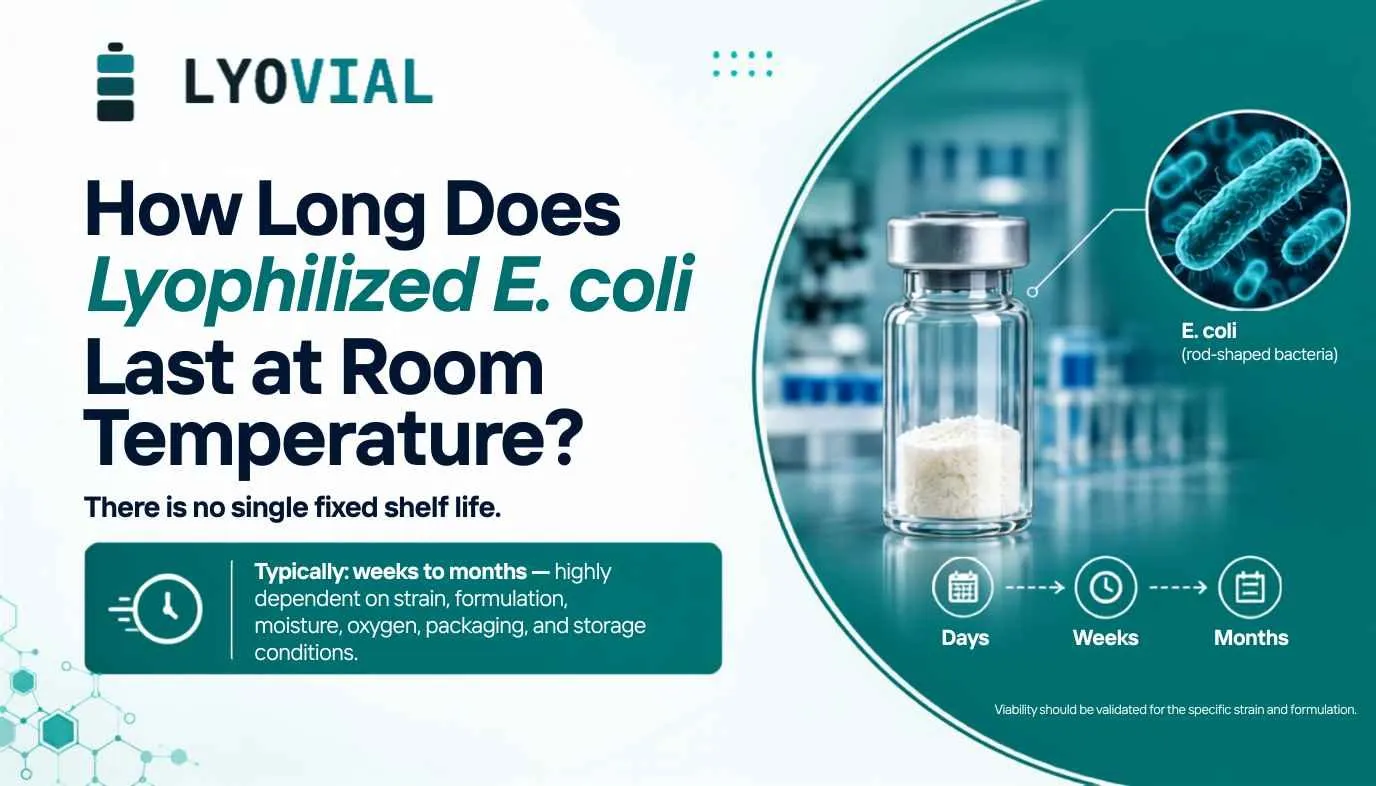
Ask three microbiologists how long do lyophilized E. coli last at room temperature, and you will get three different answers: a few weeks, a couple of years, and "we found a viable ampoule from 1978." All three people are telling the truth. They are just describing different vials.
The freeze-dried state does not stop degradation. It slows it down enormously by removing the water that chemical and enzymatic reactions need to proceed. How far it slows down depends on how much water you actually removed, what matrix the cells are sitting in, how much oxygen is trapped in the headspace, and how tightly the container keeps the outside world out. Change any one of those and the shelf life moves by an order of magnitude.
This article works through what the published data actually shows, why room-temperature storage behaves so differently from refrigerated storage, and how to establish a defensible shelf life for your own product instead of borrowing someone else's number.
The Short Answer: How Long Do Lyophilized E. coli Last at Room Temperature?
For a properly formulated, well-dried, oxygen-excluded preparation, expect 1 to 3 years of usable viability at 20–25 °C, with a slow ongoing decline rather than a cliff edge. For a hastily dried preparation in an air-filled screw-cap vial, weeks to a few months is more realistic.
Here is how the ranges break down in practice:
| Preparation quality | Typical room-temperature usable life | What limits it |
|---|---|---|
| Vacuum-sealed glass ampoule, residual moisture <1%, protective matrix | 2–5+ years | Slow oxidative and Maillard damage |
| Stoppered vial, nitrogen backfill, 1–3% residual moisture | 1–3 years | Headspace oxygen, moisture ingress through the closure |
| Stoppered vial, ambient air headspace | 6–18 months | Lipid and protein oxidation |
| Under-dried or unprotected cells (no lyoprotectant) | Weeks to ~6 months | Residual water mobility, matrix collapse |
| Anything exposed to humidity or heat in transit | Unpredictable | Moisture uptake above the glass transition |
An important framing point: viability and function are not the same question. If you need colony-forming units, you are measuring survival. If you need enzymatic activity, binding capacity, or cell-free protein synthesis from non-viable biomass, the shelf life is usually longer, because you no longer need the cell to be capable of dividing.
Why "How Long Do Lyophilized E. coli Last at Room Temperature" Has No Single Answer
Three variables dominate, and they compound.
E. coli Is Gram-Negative, Which Is the Harder Case
Gram-negative organisms consistently survive lyophilization and storage worse than Gram-positive ones. A classic ten-year study covering 100 strains across 15 genera found exactly that pattern, and it holds up in more recent work.
The reason is structural. The Gram-negative outer membrane is a lipid bilayer with lipopolysaccharide on the outer leaflet, and it is vulnerable during both the freezing step and the dehydration step. Ice crystal formation and the removal of the hydration shell around membrane phospholipids leave the membrane leaky. Cells that survive the process at all often survive with damage that shortens their storage life.
Survival Through the Cycle Sets Your Starting Point
Freeze-drying itself kills a substantial fraction of the population before storage even begins. Published survival for E. coli immediately after freeze-drying is around 42% in one well-controlled long-term study, while other work reports survival below 10% for engineered strains lyophilized without protective additives.
That number matters more than most people appreciate. If you start a two-year room-temperature stability study having already lost 90% of the population, you are starting a log lower and you have far less headroom before you fall below your release specification. Improving process survival is often cheaper than chasing storage improvements. This is why formulation and lyo cycle development is the stage where shelf life is really decided.
Storage Temperature Changes the Slope, Not the Shape
Decline in the dried state follows a roughly log-linear curve. Temperature does not change that shape. It changes the slope, and it does so steeply, because the underlying degradation chemistry — lipid oxidation, protein aggregation, Maillard browning between reducing sugars and cell proteins — is temperature-dependent.
What the Published Data Shows
The 20-Year Vacuum Ampoule Benchmark
The most useful reference dataset comes from a Japanese study published in Cryobiology that tracked freeze-dried organisms sealed in ampoules under vacuum below 1 Pa and stored in the dark at 5 °C for up to 20 years.
For E. coli, survival immediately after drying was 42.6%. During storage, the decrease in log survival was −0.041 per year, corresponding to roughly 91% of the surviving population persisting each year. The other Gram-negatives tested, Pseudomonas putida and Enterobacter cloacae, declined faster at 87.5% and 84.5% per year respectively. Gram-positive Lactobacillus acidophilus and Enterococcus faecium held near 96% per year.
At 9% loss per year, an E. coli ampoule takes about 24 years to drop one log. That is the refrigerated, vacuum-sealed, dark-stored ideal, and it explains why culture collections quote decades. A separate Bulgarian study recovered viable E. coli from lyophilized ampoules stored at 4 °C for 40 to 50 years, with morphological, serotypic, and biochemical characteristics largely intact.
Room Temperature Is a Different Curve
Direct multi-decade room-temperature datasets for lyophilized E. coli are scarce, because nobody with a valuable strain collection deliberately stores it warm. What exists is consistent and sobering.
Work on freeze-dried probiotics gives the clearest picture of the temperature penalty. Reviews of probiotic preparations note that more than 1 log of loss over a single month at 25 °C is common. In one controlled study of Lactobacillus acidophilus freeze-dried in skim milk or trehalose, viability held with no statistically significant decrease for two months at 4 °C but only 14 days at 25 °C. A freeze-dried sourdough starter declined by 3 log CFU/g over six months at room temperature.
Those organisms are Gram-positive and generally more robust in the dried state than E. coli. Treat them as an optimistic bound, not a comparison.
Non-Viable and Functional Preparations Last Longer
If your endpoint is activity rather than growth, the picture improves.
Lyophilized recombinant E. coli engineered to express acid phosphatase for cadmium bioprecipitation retained activity at room temperature for six months without significant loss, and the cells were explicitly non-viable. Separately, lyophilized E. coli cell extracts for cell-free protein synthesis retained synthesis capability at room temperature (roughly 27 °C) for 60 days past the point where aqueous extracts had degraded, holding around 85% of the protein synthesis activity of fresh aqueous extract initially.
This distinction matters commercially. Many diagnostic and reagent products built on E. coli biomass never need a living cell, which relaxes the shelf-life problem considerably. Teams building this kind of product usually work with a partner who handles diagnostic assay reagent lyophilization rather than treating it as a viability problem.
Six Factors That Decide How Long Lyophilized E. coli Last at Room Temperature
1. Residual Moisture
This is the single biggest controllable lever. ATCC targets a residual moisture content of 1% or less for bacterial ampoules, and regulatory guidance for freeze-dried biologicals has historically specified under 1% to 3%.
Water in a dried cake acts as a plasticizer. It lowers the glass transition temperature (Tg) of the amorphous matrix, and once your storage temperature approaches Tg, molecular mobility rises sharply and degradation accelerates. A cake with Tg at 45 °C is stable on a 22 °C bench. The same formulation at 4% moisture might have a Tg near room temperature, and it will fail.
Over-drying is a real failure mode too, not just a theoretical one. Work on lyophilized lactic acid bacteria found optimal stability in the intermediate water activity band of roughly 0.1 to 0.214 while still below Tg, with degradation increasing at very low moisture. A general recommendation for dried cells is to keep water activity below 0.25. The old "drier is better" rule is wrong at the extremes.
2. Oxygen in the Headspace
ATCC is explicit that oxygen chemically reacts with the product to the detriment of viability, and that this reactivity scales directly with storage temperature. Oxygen and warmth together are much worse than either alone, which is exactly why room-temperature storage in an air-filled vial performs so badly.
Sealing under vacuum or backfilling with dry nitrogen is one of the cheapest shelf-life improvements available. The 20-year ampoule study noted directly that survival during storage was strongly influenced by the degree of vacuum at sealing.
3. The Protective Matrix
Lyoprotectants are not interchangeable with cryoprotectants. Glycerol, the default for frozen stocks, is a poor lyoprotectant and is not recommended for freeze-drying.
Disaccharides such as trehalose and sucrose work by vitrifying into a glassy matrix and by hydrogen bonding to membrane phospholipid head groups in place of the water you removed. Skim milk, maltodextrin, and combinations are also widely used. Reducing sugars carry a caveat: glucose and lactose participate in Maillard reactions with cell proteins during warm storage, which is a slow but real degradation pathway over a room-temperature shelf life. Non-reducing sucrose and trehalose avoid this.
Matrix screening is worth doing empirically. Excipients that look equivalent at day zero often diverge sharply by month twelve.
4. Growth Phase and Harvest Condition
Stationary-phase cells survive both drying and storage better than log-phase cells. In the ten-year multi-strain study, log-phase survival was 44% against 62% for early stationary and 68% for late stationary. Stationary-phase cells have accumulated compatible solutes, altered their membrane lipid composition, and expressed stress regulons. They are physiologically prepared for desiccation in a way that exponentially growing cells are not.
Initial cell density matters as well. Higher starting titres provide buffer against the log losses that follow, though they do not change the decay rate.
5. Container and Closure
A perfect cake in a leaky container has no shelf life. Freeze-dried material is hygroscopic, and moisture ingress through an elastomeric stopper over 24 months can move a formulation from safely below Tg to above it.
Flame-sealed glass ampoules are the gold standard and the reason culture collections quote decades. Stoppered serum vials with a properly seated crimp are the practical compromise for most products. Screw-cap tubes with a paper insert are not a storage format, whatever the vendor implies. Getting closure integrity right is a large part of what pilot-batch vial lyophilization is for.
6. Light and Transport Excursions
Storage in the dark is standard for a reason. Shipping is where most real-world losses actually occur — a vial that spends four days at 40 °C in a truck has consumed a disproportionate share of its stability budget before it ever reaches the customer, and no amount of careful bench storage afterward recovers it.
Room Temperature Versus Refrigerated: The Real Trade-Off
The reason room-temperature storage is attractive has nothing to do with microbiology. It is logistics. Cold chain is expensive, fragile, and unavailable in exactly the field settings where a shelf-stable diagnostic is most useful.
The honest trade-off looks like this. Moving from 4 °C to 22 °C typically costs you somewhere between three and ten times the degradation rate, depending on formulation and how close your Tg sits to ambient. A product that would hold a decade refrigerated might hold two to three years on a shelf.
For many products, that is a perfectly good trade. A diagnostic kit with a two-year dated shelf life does not need thirty years of theoretical stability. For a master seed bank or a reference strain collection, it is a bad trade, and those belong at 4 °C or below regardless of what the formulation could tolerate. If you are preserving irreplaceable material, specimen library preservation is a different problem with different rules.
How to Establish Your Own Number
Do not adopt a shelf life from a paper. Generate one.
Run real-time stability. Store your actual product in your actual container at 25 °C and 60% RH, and pull at 0, 1, 3, 6, 9, 12, 18, and 24 months. Plate in triplicate. Plot log CFU against time and fit the decline. This is the only data a regulator or a customer will accept without argument.
Use accelerated studies to inform, not to replace. Elevated-temperature storage gives you a fast read on formulation ranking. One well-known finding is that two weeks of accelerated storage at 37 °C can approximate 20 years at 5 °C for vacuum-dried cultures. Treat that as a screening tool. Arrhenius extrapolation breaks down when the elevated temperature crosses the matrix Tg, because you are then measuring a different degradation mechanism than the one that operates on the shelf.
Measure the physical parameters, not just the biology. Residual moisture by Karl Fischer, water activity, Tg by DSC, and headspace oxygen at release. When a batch fails stability, these tell you why. CFU counts alone tell you only that it failed.
Define the endpoint before you start. "Viable" is not a specification. Decide whether release requires ≥10⁷ CFU/vial, or ≥50% of the day-zero count, or a functional activity threshold, and hold to it.
Labs running this kind of study on reference or control material often work with a partner accustomed to the documentation requirements — analytical testing laboratory lyophilization covers that ground.
Practical Recommendations
If you need lyophilized E. coli to hold up on a shelf:
- Harvest in late stationary phase, at the highest practical cell density.
- Formulate with a non-reducing disaccharide, screened empirically rather than chosen by default.
- Dry to 1–3% residual moisture with a water activity below 0.25, and confirm Tg sits comfortably above your maximum expected storage temperature.
- Seal under vacuum or dry nitrogen. Do not stopper in air if you can avoid it.
- Use ampoules or crimped serum vials, never screw caps, for anything with a dated shelf life.
- Store in the dark and control transit conditions as tightly as storage conditions.
- Where the application permits, refrigerate. Room-temperature capability is worth having as tolerance for excursions even when you do not rely on it.
Frequently Asked Questions
Can lyophilized E. coli survive 10 years at room temperature?
Sometimes, in a vacuum-sealed ampoule with very low residual moisture. It is not something to design around. Ten-year claims in the literature almost always refer to refrigerated storage. For a room-temperature product, 2–3 years is a defensible target and anything beyond that needs real-time data behind it.
Does the vial need to reach room temperature before opening?
Yes, and this is a common failure. Opening a cold vial in a humid room causes condensation on the cake, which will destroy it. Let the sealed vial equilibrate to room temperature for around 30 minutes before breaking the seal. Manufacturers of lyophilized reference organisms specify this step for exactly this reason.
Does an expired vial mean dead cells?
Rarely. An expiry date marks the point beyond which the manufacturer no longer guarantees the stated titre. Expired ampoules routinely yield growth. What you cannot assume is the concentration, which makes expired material unsuitable for quantitative work such as method validation or QC panels.
Is a lyophilized strain still genetically the same strain?
Broadly yes, and this is lyophilization's underrated advantage over serial subculture. Recovery of E. coli strains after 40–50 years of lyophilized storage found morphological, serotypic, and biochemical characteristics preserved. Freeze-drying halts the population dynamics that let spontaneous mutants take over a repeatedly passaged culture.
Which is better for E. coli, freeze-drying or −80 °C glycerol stocks?
They solve different problems. Glycerol stocks at −80 °C give excellent recovery and are simpler, but they depend on an uninterrupted freezer. Lyophilization gives lower immediate recovery and a much longer, transportable, freezer-independent shelf life. Serious collections keep both.
Where the Shelf Life Is Actually Won
The question of how long do lyophilized E. coli last at room temperature is really a question about the cycle that produced the vial. Residual moisture, glass transition temperature, headspace composition, and matrix selection are all locked in during process development, and none of them can be fixed afterward. A stability study does not create shelf life. It measures the shelf life your cycle already determined.
That is the case for treating cycle development as a formulation problem rather than a scheduling one. Getting excipient selection and thermal characterization right up front is what makes a two-year room-temperature claim survivable at scale-up.
LyoVial develops and locks lyophilization cycles at pilot scale for diagnostics, biotech, and microbiology teams across Canada, including freeze-dried microbiology media and supplements. If you are working out whether your preparation can hold a room-temperature claim, get in touch and we will tell you plainly what the formulation will and will not support.