
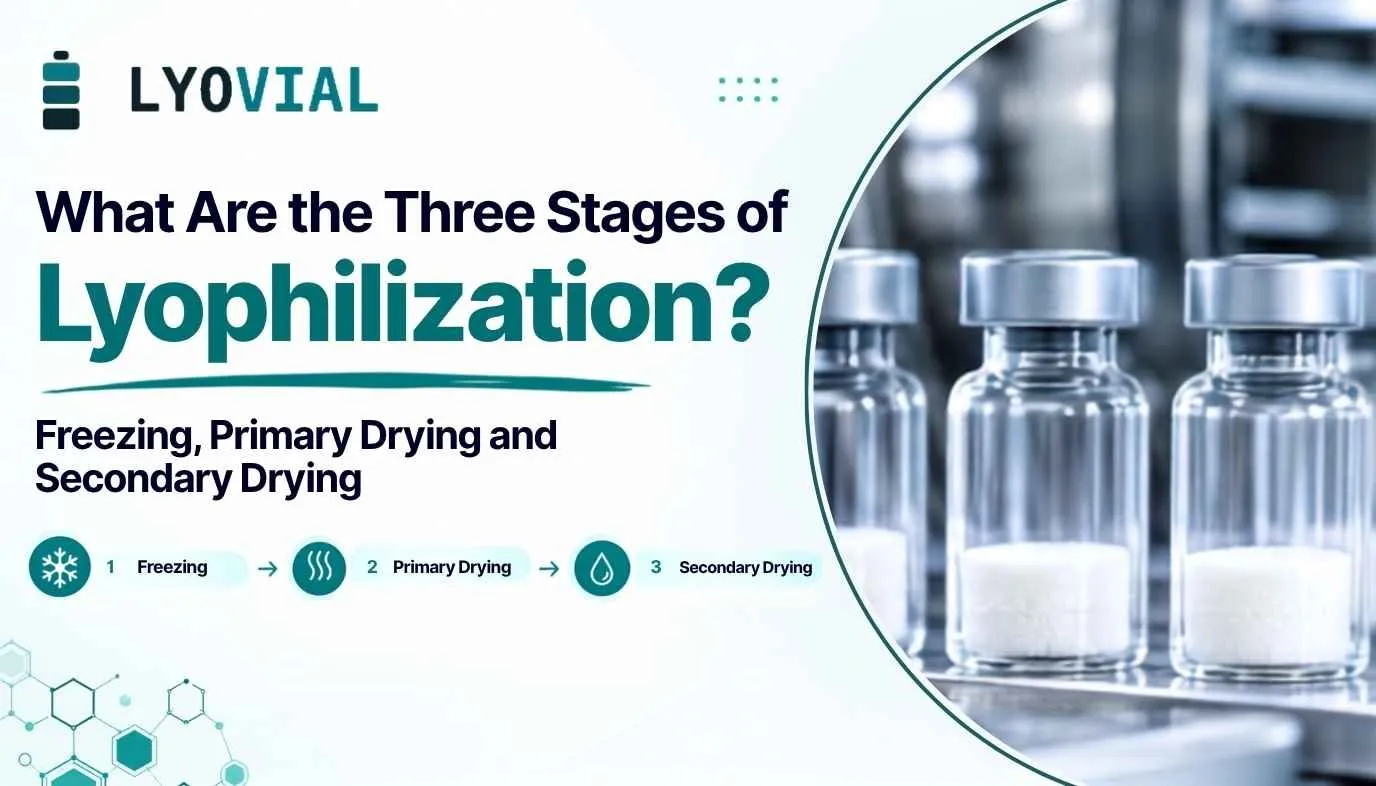
Lyophilization has three stages: freezing, primary drying, and secondary drying. Freezing converts the water in a formulation into ice and concentrates everything else into the spaces between ice crystals. Primary drying removes that ice by sublimation under vacuum, turning it directly into vapour without passing through a liquid phase. Secondary drying then removes the residual water still bound to the product matrix, using higher shelf temperatures, until the moisture content reaches a level that supports long-term stability.
| Stage | What is removed | Mechanism | Typical shelf temperature | Share of cycle time |
|---|---|---|---|---|
| 1. Freezing | Nothing yet — water is immobilized as ice | Nucleation and ice crystal growth | −40 °C to −50 °C | Hours |
| 2. Primary drying | Frozen (free) water, roughly 90–95% of total | Sublimation under vacuum | −35 °C to −10 °C | Usually the longest stage; often days |
| 3. Secondary drying | Bound (unfrozen) water adsorbed to the matrix | Desorption at higher temperature | +20 °C to +40 °C | Hours to a day |
The stages are simple to describe and difficult to execute. Almost every freeze-drying failure — collapsed cakes, long reconstitution times, activity loss at month nine of stability — traces back to a decision made in one of these three stages, usually the first one.
Stage 1: Freezing
Freezing is the stage most people skim past, and it is the stage that determines the outcome of the other two.
When a solution cools below its freezing point, water does not immediately turn to ice. It supercools, sometimes by 10–15 °C, until nucleation begins. Once the first ice crystals form, they propagate rapidly, and everything that is not water — protein, enzyme, buffer salts, sugars, stabilizers — gets pushed into the shrinking channels between the growing crystals. This is freeze concentration, and it is a far more aggressive environment than most people assume. Solute concentrations in those channels can rise by an order of magnitude, pH can shift several units as buffer components crystallize out at different rates, and a protein that was perfectly comfortable in the starting solution can denature at the ice interface.
Two properties of the frozen system govern everything that follows.
The glass transition temperature of the freeze-concentrate (Tg′) is the temperature at which the concentrated amorphous phase stops behaving like a rubbery solid and becomes a rigid glass. For crystalline systems, the equivalent parameter is the eutectic temperature (Teu). Both are measured by differential scanning calorimetry.
Collapse temperature (Tc) is the temperature above which the dried cake structure loses rigidity during drying and the pores close in on themselves. It is typically a few degrees above Tg′ and is observed directly by freeze-dry microscopy. This single number sets the ceiling for primary drying, and a cycle designed without it is a cycle designed on hope.
Why ice crystal size is a genuine trade-off
Fast freezing produces many small ice crystals. Slow freezing produces fewer, larger ones. Neither is universally correct.
Large crystals leave large pores when they sublime, which means lower resistance to vapour flow and faster primary drying. Small crystals leave a finer pore structure, which dries more slowly but often reconstitutes faster and can be gentler on some proteins.
Because nucleation is stochastic, vials in the same batch nucleate at different temperatures and end up with different pore structures. That is the physical reason batch uniformity is hard to achieve. Two techniques address it:
Annealing holds the frozen product at a temperature above Tg′ for a period, allowing small crystals to recrystallize into larger, more uniform ones. It can substantially shorten primary drying and improve consistency across the shelf.
Controlled nucleation forces every vial to nucleate at the same moment, usually by a rapid pressure change or ice fog introduction. It is the most direct answer to nucleation variability, though it requires equipment that supports it.
These decisions belong in formulation and cycle development, not in production. A freezing profile chosen casually becomes an expensive problem once it is locked into a validated process.
Stage 2: Primary drying (sublimation)
Primary drying is where the ice leaves. It typically removes 90–95% of the total water in the product, and it usually consumes most of the cycle — often one to three days, and considerably longer for high fill volumes or conservative cycles.
The physics are straightforward. Chamber pressure is reduced below the vapour pressure of ice at the product temperature, which makes sublimation thermodynamically favourable. Sublimation absorbs energy, so heat has to be supplied through the shelves to keep the process moving. The water vapour travels from the product, through the chamber, and onto the condenser, which sits far colder than the shelves and traps it as ice.
Typical chamber pressures fall somewhere between about 50 and 300 mTorr depending on product sensitivity, and shelf temperatures during primary drying are commonly in the −35 °C to −10 °C range. Those are ranges, not recommendations — the correct values come from your product's thermal data.
The one rule that matters
Product temperature must stay below the collapse temperature for the entire stage.
Shelf temperature and product temperature are not the same thing. The product sits below the shelf setpoint during active sublimation because sublimation is endothermic and cools the product as it proceeds. The gap between them closes as the ice front recedes and the dried layer above it insulates what remains.
Push the shelf too hot, and the product crosses Tc. The cake softens, the pore structure collapses, and you get a shrunken, glassy plug instead of an elegant cake — with trapped moisture, slow reconstitution, and compromised stability. Run too cold, and you are safe but slow, sometimes adding days of chamber time per batch for no product benefit.
Every primary drying cycle is a negotiation between those two failure modes, which is exactly why the thermal characterization in stage one is not optional.
Why the shelf edge behaves differently
Containers at the edge of a shelf receive radiant heat from the chamber walls and door in addition to conductive heat from the shelf. They sublime faster and run warmer than containers in the middle.
At laboratory scale with a partial load, this is a footnote. At full production load, it is the reason a batch can be simultaneously over-dried at the perimeter and incompletely dried at the centre. Any provider running a validated process should be able to show you a shelf-position uniformity mapping study performed at full chamber load, with thermocouple placement and acceptance criteria documented. If they cannot, scale-up is an open risk.
Knowing when primary drying has actually ended
Ending primary drying early is a common and expensive mistake, because residual ice carried into secondary drying can melt as the shelves warm — producing meltback that is often invisible until release testing.
The standard method for detecting the endpoint is comparative pressure measurement: a Pirani gauge reads pressure differently depending on gas composition, while a capacitance manometer does not. While water vapour dominates the chamber, the two gauges disagree. As sublimation finishes and the chamber fills with nitrogen instead, the Pirani reading converges toward the capacitance manometer. That convergence is the signal.
Other approaches include tunable diode laser absorption spectroscopy for direct vapour flow measurement, and pressure rise testing. The point is that a competent cycle has an evidence-based endpoint rather than a fixed duration inherited from another product.
Stage 3: Secondary drying (desorption)
At the end of primary drying, the product looks dry. It is not. Somewhere between 5% and 20% of the total water is still there, hydrogen-bonded to the solid matrix rather than frozen, and it will not sublime because it is not ice.
Removing it requires desorption, which requires energy. Shelf temperature is ramped up — commonly to somewhere between +20 °C and +40 °C — and held while bound water diffuses out of the amorphous matrix and into the chamber.
Two things make this stage less trivial than it looks.
The ramp rate matters. Raising the shelf temperature too quickly, before enough bound water has left, can carry the product above the glass transition temperature of the partially dried cake and cause collapse at the very end of an otherwise successful cycle. The safe temperature rises as the product dries, so the ramp has to respect that.
Drier is not always better. There is a widespread assumption that residual moisture should be pushed as low as possible. For many products that is true, but for some proteins and live biological materials, over-drying is destabilizing — the last fraction of water participates in maintaining conformational structure, and removing it accelerates degradation. The target is a specification derived from stability data for your product, not a universal number.
Residual moisture is measured by Karl Fischer titration, sometimes supported by thermogravimetric or loss-on-drying methods. It is one of the most important release attributes for a lyophilized product, and the turnaround time on that assay often sets the pace of an entire development programme. This is a large part of why in-house analytical testing matters so much when choosing a manufacturing partner.
What happens after the third stage
The cycle is not quite over when secondary drying ends.
For vials, stoppers are seated inside the chamber — usually under vacuum or after backfilling with nitrogen — before the chamber returns to atmospheric pressure. Stoppering inside the chamber protects a hygroscopic cake from picking up atmospheric moisture in the seconds between unloading and sealing. The stopper itself matters too: elastomeric closures absorb moisture during autoclaving and can release it into the headspace over months, quietly raising residual moisture beyond specification.
For lyophilized beads and other unit-dose formats, the equivalent step is controlled transfer into low-humidity packaging with an appropriate desiccant, since there is no individual container sealed in the chamber.
Where each stage goes wrong
| Stage | Common failure | Usual root cause |
|---|---|---|
| Freezing | Inconsistent cake structure across the batch | Uncontrolled nucleation; no annealing step |
| Freezing | Activity loss before drying even begins | Freeze concentration, pH shift, ice-interface denaturation |
| Primary drying | Collapsed or shrunken cake | Product temperature exceeded collapse temperature |
| Primary drying | Meltback | Primary drying ended before all ice sublimed |
| Primary drying | Edge vials out of specification | Uniformity never mapped at full chamber load |
| Secondary drying | Late-stage collapse | Shelf ramp too aggressive for the partially dried matrix |
| Secondary drying | Poor stability despite low moisture | Over-drying a moisture-sensitive biological |
| Post-cycle | Moisture creep on stability | Stopper moisture release; inadequate desiccation or packaging |
Frequently asked questions
What are the three stages of lyophilization?
Freezing, primary drying and secondary drying. Freezing immobilizes the water as ice and concentrates the remaining solutes. Primary drying removes that ice by sublimation under vacuum. Secondary drying removes the bound water still adsorbed to the product matrix using higher shelf temperatures.
Which stage of lyophilization takes the longest?
Primary drying, almost always. It commonly runs one to three days and can run considerably longer for large fill volumes or conservative cycles, because it removes the great majority of the water and the sublimation rate is limited by how much heat can be supplied without exceeding the product's collapse temperature.
What is the difference between primary and secondary drying?
Primary drying removes frozen water by sublimation — ice converting directly to vapour under vacuum at low temperature. Secondary drying removes unfrozen water that is bound to the solid matrix, by desorption at substantially higher shelf temperatures. Different water, different mechanism, different temperature regime.
Is freeze-drying the same as lyophilization?
Yes. Freeze-drying is the everyday term and lyophilization is the technical term used in pharmaceutical and diagnostics manufacturing. They describe the same process.
Why must the product stay below the collapse temperature?
Above the collapse temperature, the amorphous concentrate in the partially dried cake softens enough to lose structural rigidity. The pore network closes, producing a shrunken or glassy plug rather than a porous cake. Consequences include trapped moisture, slow or incomplete reconstitution, poor appearance and reduced stability. Collapse is generally irreversible.
What residual moisture should a lyophilized product have?
There is no universal target. Many pharmaceutical products specify low single-digit percentages, but the correct specification is derived from stability data for the specific formulation. Some proteins and live biological materials are destabilized by over-drying, so lower is not automatically better.
What is annealing in freeze-drying?
A hold step during freezing in which the product is warmed above the glass transition temperature of the freeze-concentrate and held before cooling again. It lets small ice crystals recrystallize into larger, more uniform ones, which improves batch uniformity and can shorten primary drying significantly.
Getting the three stages right for your product
The three stages are the same for every product. The parameters are not, and they cannot be borrowed from a similar formulation with any confidence — a change in fill volume, buffer system or container geometry moves the entire design space.
A sound cycle starts with measured thermal properties for your specific formulation, sets primary drying to run as warm as safely possible below collapse, uses evidence rather than a timer to determine the endpoint, and ramps secondary drying to a moisture target justified by stability data.
Lyovial provides contract lyophilization services in Canada, covering thermal characterization, formulation development, cycle optimization, unit-dose bead manufacturing, analytical testing and validated commercial production from a single facility under one quality system.
If you are evaluating providers, our guide to choosing a contract freeze-drying partner covers the questions worth asking. If you already have a formulation and want to know how it will behave through these three stages, get in touch.