
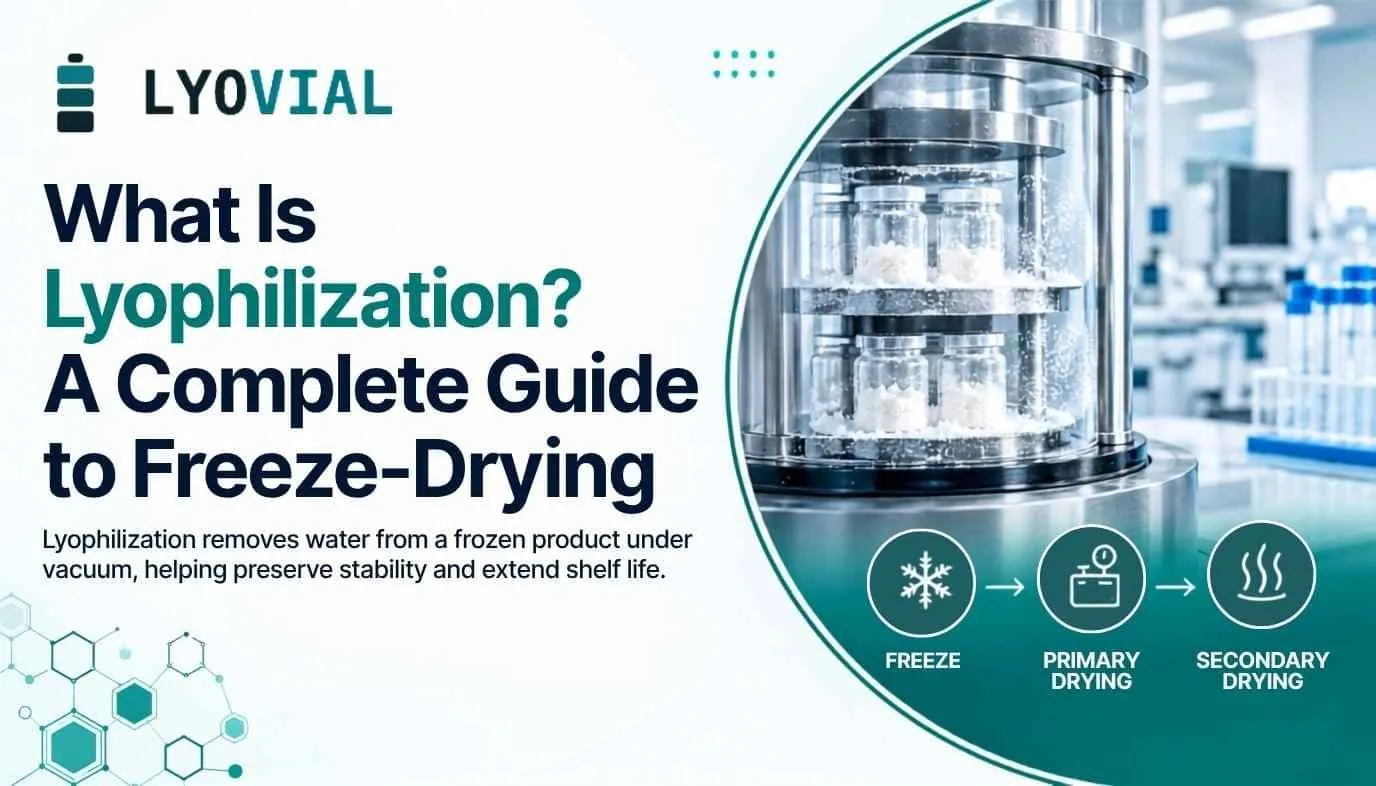
Most people asking what is lyophilization have already been told it means freeze-drying, and have correctly sensed that the answer is incomplete. Freeze-drying describes what you see. It does not explain why a process that takes three days and a machine costing several hundred thousand dollars beats simply putting the product in a warm oven.
The short version: lyophilization removes water from a frozen product by turning ice directly into vapour, skipping the liquid phase entirely. The product never thaws, never gets hot, and never experiences the surface tension forces that destroy proteins and cell membranes during ordinary evaporative drying. What comes out is a dry, porous cake that dissolves back into solution in seconds and holds its potency for years on a shelf.
This guide covers the physics, the three stages of the cycle, the critical temperatures that decide whether a batch succeeds or collapses, what the excipients are actually doing, and the real trade-offs involved.
What Is Lyophilization? The Working Definition
Lyophilization is a low-temperature dehydration process in which a material is frozen, then placed under vacuum so that the ice sublimes directly to water vapour without passing through a liquid state. The vapour is captured on a cold condenser, and the remaining bound water is driven off by gentle heating.
The word comes from the Greek lyo (to loosen or dissolve) and philos (loving). A properly made lyophilized cake is "solvent-loving" — it takes water back readily and reconstitutes in seconds. That reconstitution behaviour is the whole point of the name, and it is also the first thing a bad cycle destroys.
Is lyophilization the same as freeze-drying? Yes, exactly the same process. The difference is vocabulary by industry. Pharmaceutical, biotech, and diagnostics settled on lyophilization decades ago; food and ingredient manufacturing say freeze-drying. If a supplier uses one term and your protocol uses the other, nothing technical is different.
The Physics: Why Sublimation Works
Everything in lyophilization follows from one point on the phase diagram of water.
Water has a triple point at 0.0099 °C and 611.66 Pa — about 4.58 mmHg, or 6.11 mbar. Below that pressure, liquid water cannot exist at any temperature. There is solid, and there is vapour, and nothing in between.
That is the entire trick. Drop the chamber pressure below the triple point while the product is frozen, supply just enough heat to satisfy the latent heat of sublimation, and ice converts straight to vapour. The frozen structure stays put while the water leaves through it, which is why the finished cake retains the shape and volume of the original solution instead of shrinking into a hard pellet.
Two things follow from this that trip people up:
Vacuum alone does not dry anything. Sublimation absorbs roughly 2,830 kJ per kilogram of ice. Without heat input from the shelves, the product simply cools itself until sublimation stops. The shelves are supplying energy, not warming the product in the ordinary sense.
Lower pressure is not always better. Water vapour has to physically travel from the sublimation front, through the already-dried layer above it, out of the vial, and across to the condenser. Below roughly 50 mTorr, heat transfer from shelf to product becomes inefficient because there is too little gas to conduct through. Most primary drying runs between 50 and 250 mTorr for this reason.
The Three Stages of a Lyophilization Cycle
Every cycle has the same three segments. Their relative importance is almost the opposite of what people assume.
Stage 1: Freezing
Freezing looks trivial and is the most consequential stage in the cycle.
The product is cooled, typically to somewhere between −40 °C and −50 °C, until the solution is fully solidified. What matters is not that it froze but how it froze, because ice crystal size and distribution set everything downstream.
Fast freezing produces many small ice crystals. Small crystals leave narrow pores in the dried cake, which restricts vapour escape and makes primary drying slow. Slow freezing produces large crystals and wide pores, which dry quickly, but the larger crystals impose more mechanical stress on proteins and cell membranes.
Two additional processes happen during freezing that people forget about:
- Freeze concentration. As pure ice forms, everything else is pushed into a shrinking volume of unfrozen solution. Buffer salts, protein, and API all concentrate dramatically. Sodium phosphate buffers are notorious here — the dibasic form crystallises out preferentially, dropping local pH by several units and denaturing protein before drying has even started.
- Annealing. Holding the frozen product at an intermediate temperature for a period lets small crystals recrystallise into larger ones, evening out the pore structure and improving batch uniformity. It adds hours to the cycle and frequently saves more time than it costs.
Stage 2: Primary Drying (Sublimation)
Chamber pressure drops below the triple point and shelf temperature rises. Ice sublimes from a front that moves progressively downward through the vial.
Primary drying removes the large majority of total water and is by far the longest segment, routinely accounting for most of a cycle that runs 40 to 60 hours or longer. Because it dominates the timeline, it also dominates the economics.
The governing constraint is that product temperature must stay below the critical formulation temperature at all times. Exceed it and the dried layer softens, loses its structure, and collapses in on itself.
This creates the central tension of cycle design. Warmer means faster — as a rule of thumb, each 1 °C increase in product temperature cuts primary drying time by roughly 13%. Warmer also means closer to collapse. Cycle development is largely the work of finding how close to that edge you can safely operate, and then leaving a defensible margin.
Note that shelf temperature and product temperature are not the same number. Sublimation cools the product, so a shelf at −20 °C may hold product at −35 °C while ice is still subliming. When the ice runs out, that cooling stops and product temperature climbs toward shelf temperature quickly. Ending primary drying too early is a common and expensive mistake.
Stage 3: Secondary Drying (Desorption)
Even after all the ice is gone, 5–20% water by weight remains, bound to the solid matrix and never frozen at all. Removing it is desorption, not sublimation, and it requires a different approach: shelf temperature raised substantially, often to 25–40 °C, held for several hours.
Target residual moisture for most biological products is 1–3%, and often below 1% for freeze-dried cultures and vaccines.
Counter-intuitively, drier is not automatically better. Over-drying can strip water that a protein needs for conformational stability, and some formulations show reduced stability at very low moisture. The target is a range, established experimentally, not a floor.
The Critical Temperatures That Decide Everything
Three numbers determine what your cycle can and cannot do. Get them measured before you design anything.
Eutectic temperature (Te) applies to formulations that crystallise. It is the temperature below which the entire system is solid. Stay under it during primary drying and you are safe.
Glass transition temperature of the maximally freeze-concentrated solution (Tg′) applies to amorphous formulations, which covers most protein and sugar-based products. Below Tg′ the freeze-concentrate is a rigid glass; above it, it becomes a viscous rubber with enough molecular mobility to flow.
Collapse temperature (Tc) is the product temperature during drying above which the cake loses its macroscopic structure. For amorphous systems it typically sits about 2 °C above Tg′ and is measured directly by freeze-drying microscopy.
A collapsed cake is not a cosmetic problem. It has higher residual moisture, because the pore structure that secondary drying depends on is gone. It reconstitutes slowly or incompletely. It usually fails visual inspection. And it often fails stability, because the elevated moisture drives exactly the degradation the process was meant to prevent.
A useful practical move for formulations with an awkwardly low Tc: add a crystalline bulking agent with a high eutectic temperature, such as mannitol or glycine. It gives the cake a rigid scaffold and lets you run primary drying warmer than the amorphous phase alone would tolerate. Getting this balance right is the substance of formulation and lyo cycle development.
What the Excipients Are Doing
A lyophilized formulation is rarely just API and water. Each component has a job.
| Component | Examples | Function |
|---|---|---|
| Bulking agent | Mannitol, glycine, lactose | Provides cake structure and mass, especially at low API concentration |
| Lyoprotectant / stabiliser | Sucrose, trehalose | Vitrifies into a glassy matrix and hydrogen-bonds to the molecule in place of removed water |
| Buffer | Histidine, citrate, Tris | Holds pH through freeze concentration; phosphate is often a poor choice |
| Surfactant | Polysorbate 20/80 | Prevents interfacial aggregation at the ice–liquid boundary |
| Tonicity modifier | Sodium chloride, mannitol | Makes the reconstituted solution physiologically compatible |
The stabiliser deserves a note. The water replacement hypothesis holds that disaccharides like sucrose and trehalose hydrogen-bond to protein surfaces and membrane phospholipid head groups, substituting for the hydration shell that drying removes and holding the native conformation in place. The vitrification hypothesis holds that they form a rigid glass which immobilises the molecule so degradation cannot proceed. Both are real, and both contribute.
Reducing sugars carry a caveat. Glucose and lactose participate in Maillard reactions with protein amine groups during warm storage — slow, but real over a two-year shelf life. Non-reducing sucrose and trehalose avoid it, which is why they dominate biologic formulations.
Why Lyophilization Is Used
The alternatives to lyophilization all involve heat, liquid surfaces, or both, and the molecules that most need preserving tolerate neither.
Stability without cold chain. Proper formulation can move a biologic from 12 months refrigerated to well over 36 months at ambient conditions. For vaccines and diagnostics distributed to regions without reliable refrigeration, this is the difference between a viable product and an unusable one.
No thermal damage. The product never exceeds a few degrees above ambient, and spends most of the cycle far below zero.
Fast, complete reconstitution. The porous cake has enormous surface area and rehydrates in seconds. A heat-dried equivalent forms a dense glass that dissolves poorly and can leave undissolved particulates in an injectable.
Accurate unit dosing. Filling as a liquid and drying in the final container gives precise, uniform dose per vial, which powder filling struggles to match at small fill weights.
Weight and volume reduction for shipping. Removing 95%+ of the mass matters for anything moving by air.
The market reflects this. More than half of marketed biopharmaceuticals are supplied as lyophilized formulations, and over 30% of FDA-approved parenteral drugs are lyophilized. Fourteen of the nineteen antibiotics on the WHO Essential Medicines list are supplied as freeze-dried powders. According to the LyoHub 2023 annual report, 336 lyophilized drugs were approved between 2012 and 2022 — 59% of all lyophilized drug filings since 1954, concentrated into a single decade.
The Downsides Nobody Puts in the Brochure
It is slow. Three days is a normal cycle. A week is not unusual. Every hour is capital tied up in a machine that can only run one batch at a time.
It is expensive. Freeze-drying is among the costliest drying methods per unit of water removed. Refrigeration, vacuum, and the latent heat of sublimation all draw significant energy, continuously, for days.
It is unforgiving. There is no partial credit. A batch that collapses in hour 30 of a 60-hour cycle is a total loss, and you usually find out at the end.
It does not scale linearly. Heat transfer, edge effects at the shelf perimeter, condenser capacity, and vapour flow all shift when you move from 50 vials to 5,000. A cycle validated on a benchtop unit frequently fails at pilot scale for reasons that have nothing to do with the formulation. This is a well-known failure mode and the reason scale-up and technology transfer is treated as its own discipline rather than a scheduling exercise.
Freezing stress is a real hazard. Some proteins are damaged more by freezing than by any subsequent step. Lyophilization is not gentle by default; it is gentle when correctly designed.
What Is Lyophilization Used For?
The applications extend well past injectable drugs:
- Biologics and vaccines — monoclonal antibodies, recombinant proteins, peptides, conjugates, live attenuated and subunit vaccines
- Diagnostic reagents — enzymes, oligonucleotides, antibodies, and detection chemistries stabilised into ambient-stable freeze-dried assay reagents for IVD kits and lateral flow
- Calibrators and controls — QC materials that must hold assigned values across lots and years
- Microbiological cultures and media — reference strains, starter cultures, and freeze-dried media and supplements
- Analytical reference materials — standards requiring homogeneity and accurate reconstitution
- Cosmetic actives — peptides and botanicals preserved in single-dose format
- Food — coffee, fruit, and complete meals, where structure and flavour retention justify the cost
For a fuller treatment of where the process earns its cost, see lyophilization uses.
Lyophilization Compared With Other Drying Methods
| Method | Temperature | Product stress | Reconstitution | Cost | Best for |
|---|---|---|---|---|---|
| Lyophilization | Below freezing | Freezing and dehydration stress | Seconds, complete | High | Biologics, live cultures, injectables |
| Spray drying | 80–200 °C inlet | Thermal and shear | Good | Moderate | Heat-tolerant powders, high volume |
| Vacuum drying | 30–60 °C | Thermal, liquid surface tension | Poor, dense product | Low | Robust small molecules |
| Air drying | Ambient to 60 °C | Thermal, oxidative, surface tension | Poor | Very low | Non-sensitive materials |
Spray drying is the genuine competitor for some applications: continuous, far cheaper, much faster. It fails on anything that cannot survive a hot gas stream and an air–liquid interface, which rules out most live organisms and many proteins.
How to Tell a Good Cake From a Bad One
Visual inspection catches most cycle failures:
- Good — uniform, opaque, occupying the full original fill volume, with a clean edge and no shrinkage from the vial wall
- Collapse — glassy, shrunken, dense; the cake looks melted because it partially was
- Meltback — a shiny layer at the base where ice liquefied before subliming
- Shrinkage — cake pulled away from the glass, indicating structural weakness even without full collapse
- Powdering or blowout — material lifted and scattered, usually from too aggressive a vacuum ramp
- Long reconstitution — a cake that takes minutes rather than seconds has lost its porous structure
These are visible symptoms of process problems, and they are diagnostic. Collapse points at the temperature margin. Meltback points at heat input or pressure control. Blowout points at the ramp. Documentation of what a good cake looks like for your product, batch after batch, is part of what a defensible quality and compliance framework is built on.
Frequently Asked Questions
What is lyophilization in simple terms?
Freezing something solid, then pulling a vacuum so the ice evaporates straight out as vapour without melting first. The result is a dry, spongy solid that keeps its shape, keeps its potency, and dissolves instantly in water.
How long does a lyophilization cycle take?
Typically 24 to 72 hours for pharmaceutical products, sometimes a week for large fill volumes or difficult formulations. Primary drying accounts for most of it.
What is the difference between lyophilization and freeze-drying?
None. They are two names for the same process, split along industry lines. Pharma says lyophilization; food says freeze-drying.
Why is lyophilization done under vacuum?
Because below water's triple point pressure of 611 Pa, liquid water cannot exist. That forces ice to convert directly to vapour, which is what keeps the product frozen and structurally intact throughout drying.
Can any product be lyophilized?
Most aqueous formulations can, but not all should. Products with very low collapse temperatures need reformulation to be practically manufacturable, and organic solvent systems require specific equipment considerations. A feasibility assessment answers this quickly and cheaply, well before you commit to a cycle.
Does lyophilization sterilise the product?
No. It removes water and stops microbial growth, but it does not kill organisms — that is precisely why it is used to preserve bacterial cultures. Sterility comes from aseptic processing, not from the dryer.
What residual moisture should a lyophilized product have?
Usually 1–3%, and often below 1% for freeze-dried cultures and vaccines. The correct target is established for each formulation, since over-drying can be as damaging as under-drying.
The Part That Actually Determines Success
Having worked through what is lyophilization at a technical level, the practical conclusion is narrower than the topic suggests. The equipment matters less than most people expect. Two facilities running identical dryers will get very different results from the same formulation, because the cycle is where the knowledge lives.
Formulation characterisation, Tg′ and collapse temperature measurement, the freezing profile, the pressure and temperature ramps, the primary drying endpoint, the secondary drying hold — those parameters are the product. Everything after is execution.
That is also why cycles fail at scale-up. A process developed by trial and error on a benchtop unit has no documented rationale to transfer, so when heat transfer changes at pilot volume, there is nothing to reason from.
LyoVial develops and locks lyophilization cycles at pilot-batch vial scale for diagnostics, biotech, and research teams across Canada, with the batch records and cycle documentation structured to transfer cleanly to whoever manufactures next. If you have a formulation and need to know whether it can be freeze-dried properly, get in touch and we will tell you plainly what will and will not work.