
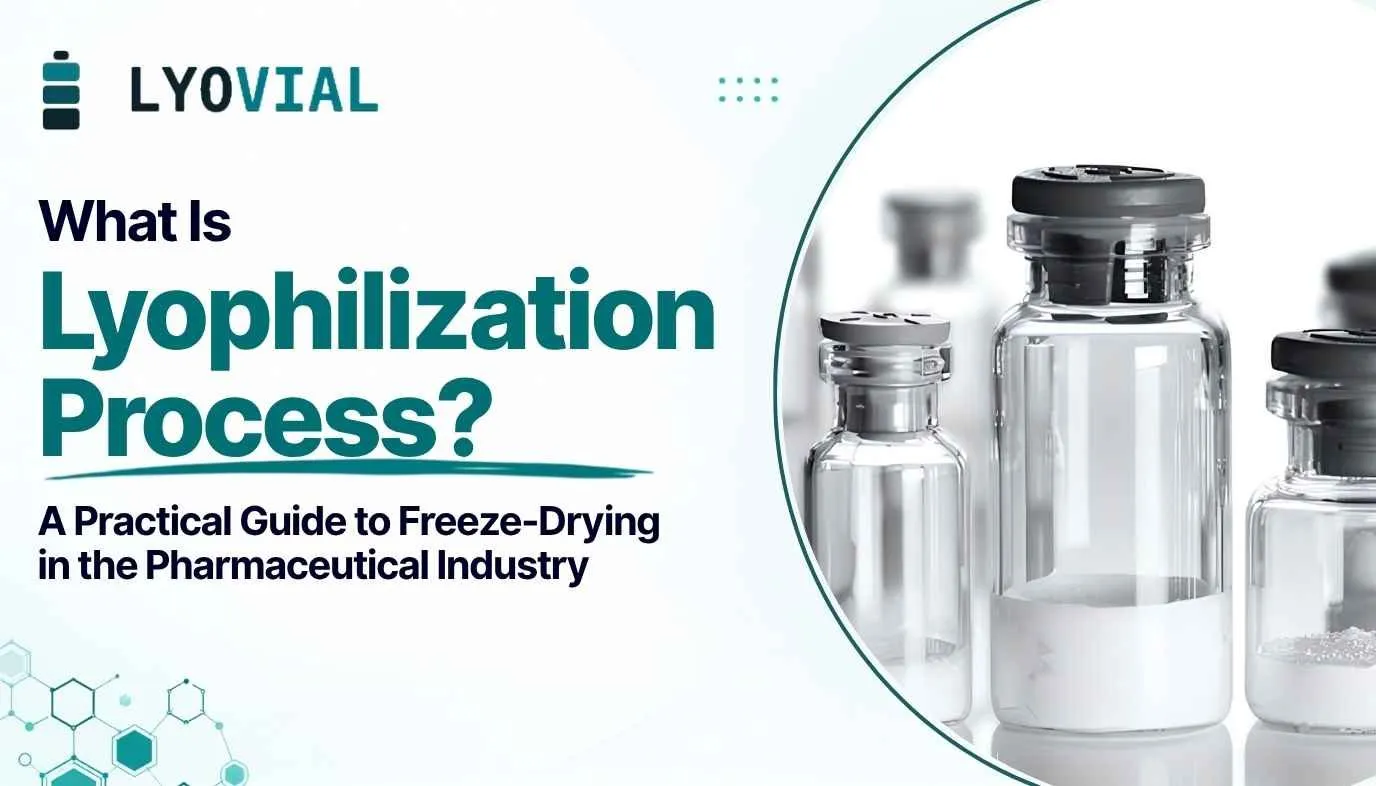
If you've ever mixed a vial of powder with sterile water before an injection, you've handled a lyophilized product. That dry, slightly crumbly "cake" at the bottom of the vial is the end result of one of the slowest, most expensive, and most carefully controlled operations in pharmaceutical manufacturing.
It's also one of the most important. Many biologics, vaccines, diagnostic reagents, and reference standards simply wouldn't survive long enough on a shelf to be useful without it.
In this guide, we'll answer two questions people search for all the time: what is the lyophilization process, and how does lyophilization work in practice? We'll go through the science, each stage of a typical cycle, the things that go wrong, and what it takes to develop a cycle that actually holds up at scale.
What Is the Lyophilization Process?
Lyophilization is a low-temperature drying process that removes water from a product by freezing it first and then turning the ice directly into vapor under vacuum, without letting it melt. The water skips the liquid phase entirely. This phase change, solid straight to gas, is called sublimation.
You'll hear "lyophilization" and "freeze-drying" used interchangeably, and they mean exactly the same thing. "Lyophilization" comes from Greek roots meaning roughly "made solvent-loving," a nod to how readily a well-made freeze-dried product dissolves again when you add liquid back.
The end product is usually a porous, dry solid with very low residual moisture. Because so little water remains, most of the chemical and physical reactions that degrade a drug in solution slow down dramatically. The product can then be stored for months or years, often at refrigerated or even room temperature, and brought back to life (reconstituted) just before use.
The technique isn't new. Freeze-drying was scaled up during the Second World War to preserve blood plasma and penicillin for the battlefield, and the pharmaceutical industry has been refining it ever since.
Why the Pharmaceutical Industry Relies on Freeze-Drying
Water is the enemy of stability for a lot of drug molecules. In solution, proteins can unfold, aggregate, or get chemically modified through hydrolysis, deamidation, and oxidation. Small molecules can hydrolyze. Live organisms and cells lose viability. Take the water away gently, and most of those problems slow to a crawl.
That's why freeze-drying has become so central, especially for biologics. Around half of the biopharmaceutical products on the FDA and EMA approved lists are made using lyophilization, according to a review of lyophilization in injectable formulations published in ScienceDirect. The same review notes that more than 30% of FDA-approved parenteral (injectable) drugs are lyophilized.
The trend is still moving upward. Industry data from the LyoHub 2023 report, summarized by PCI Pharma Services, shows that 336 lyophilized drugs were approved between 2012 and 2022, which accounts for well over half of all lyophilized drug filings since 1954.
So why not freeze-dry everything? Because it's slow and costly. A single cycle can run anywhere from a day to more than a week, and the equipment is expensive to buy, run, and maintain. Manufacturers choose lyophilization when the stability benefits genuinely outweigh that cost, which, for sensitive molecules, they usually do.
The main benefits come down to:
- Longer shelf life. Products that would last weeks or months in liquid form can last years when dried.
- Easier storage and shipping. Many lyophilized products tolerate higher temperatures, which reduces cold-chain pressure.
- Accurate dosing. The drug is filled as a liquid, which is far easier to dose precisely than a powder, and then dried in the vial.
- Sterility. Vials can be filled aseptically and stoppered inside the freeze-dryer without ever being exposed to the room.
- Fast reconstitution. A well-formed porous cake dissolves in seconds.
The Science Behind It: Sublimation and the Triple Point
To understand how lyophilization works, it helps to look at water's phase diagram for a moment.
Water can exist as a solid, liquid, or gas depending on temperature and pressure. At everyday atmospheric pressure, ice melts to liquid before it evaporates. But below a specific pressure and temperature, known as the triple point (about 0.01 °C and roughly 611 Pa, or 4.6 Torr), liquid water can't exist stably. Under those conditions, ice goes straight to vapor.
A freeze-dryer takes advantage of this. It keeps the product frozen and holds the chamber at a pressure far below the triple point, typically in the range of tens to a couple of hundred millitorr. Then it adds just enough heat to drive sublimation without letting the product warm up past its critical temperature.
That balancing act, adding heat to speed up drying while keeping the product cold enough to stay intact, is really the whole game in lyophilization.
How Does Lyophilization Work? The Three Stages
A lyophilization cycle has three main stages: freezing, primary drying, and secondary drying. Each one has its own purpose, and a mistake at any of them can ruin a batch.
Stage 1: Freezing
It sounds like the easy part. It isn't.
After the liquid formulation is filled into vials and the stoppers are partially inserted (so vapor can escape later), the vials are loaded onto temperature-controlled shelves inside the freeze-dryer. The shelves are then cooled, often to somewhere around −40 °C to −50 °C, depending on the formulation.
As the product cools, water crystallizes into ice. The solutes, such as the active ingredient, sugars, buffers, and salts, get pushed into the narrow spaces between ice crystals and become highly concentrated. Depending on what's in the formulation, this concentrated phase either crystallizes too or solidifies into an amorphous glass.
Two things about freezing matter a lot more than most people expect:
Ice crystal size. The ice crystals formed here will later leave behind empty pores when they sublime. Large crystals leave large pores, which let vapor escape easily and make primary drying faster. Small crystals create a dense structure that resists vapor flow and slows everything down. Crystal size depends heavily on how and when the solution nucleates.
Nucleation. Water often supercools well below 0 °C before it starts freezing, and it does so at random. That means vials on the same shelf can freeze at different temperatures, with different ice structures, and then dry at different rates. Techniques like controlled nucleation (triggering ice formation in all vials at once) and annealing (warming the frozen product briefly to let small crystals grow into larger ones) help reduce this vial-to-vial variability.
Annealing also serves another purpose. Crystalline excipients like mannitol need to fully crystallize during freezing. If they don't, they can crystallize later during storage, which can damage the product or even crack the vial.
Stage 2: Primary Drying (Sublimation)
This is the longest stage, and where most of the water leaves.
Once the product is completely frozen, the condenser is chilled (often to −60 °C or colder), and a vacuum pump pulls the chamber pressure down. The shelves are then warmed slightly to supply the energy needed for sublimation. Ice at the top of the frozen product turns to vapor, travels up through the dried layer above it, out through the gap in the partially seated stopper, and freezes onto the condenser coils.
The sublimation front moves slowly downward through the product, leaving behind a porous dried layer. Primary drying removes the frozen, "free" water, which is the bulk of the water in the product.
The critical rule of primary drying is simple: the product temperature must stay below its critical temperature. For amorphous formulations, that's usually the collapse temperature, which sits close to the glass transition temperature of the freeze-concentrate, known as Tg′. For crystalline systems, it's the eutectic temperature. For a sucrose-based formulation, Tg′ sits around −32 °C, so the product has to be kept colder than that during sublimation.
If the product warms past that threshold, the dried structure loses its rigidity, and the pores fall in on themselves. That's called collapse, and we'll come back to it below.
Here's the frustrating part. Running primary drying colder is safer, but much slower. As a common rule of thumb in the field, every 1 °C increase in product temperature can shorten primary drying time by roughly 13%. So cycle developers try to run as close to the critical temperature as they safely can, usually a few degrees below it, to avoid wasting days of equipment time.
How do you know primary drying is finished? Most modern freeze-dryers use a comparison between two pressure gauges: a capacitance manometer (which reads true pressure) and a Pirani gauge (which is sensitive to water vapor). While ice is still subliming, the Pirani reads higher. When the two readings converge, the water vapor is gone, and primary drying is essentially complete.
Stage 3: Secondary Drying (Desorption)
After sublimation, the product looks dry. It isn't quite there yet.
A meaningful amount of water is still bound to the solid, trapped in the amorphous matrix or adsorbed onto surfaces. This water never froze, so sublimation can't remove it. Secondary drying handles it through desorption.
The shelf temperature is raised further, commonly to somewhere between 20 °C and 40 °C, while the chamber stays under low pressure. This gives the bound water enough energy to escape. The goal is usually a final residual moisture of around 1–2%, though the right target depends on the product. Some proteins are actually less stable if they're over-dried, so "drier" isn't always "better."
Secondary drying typically takes a few hours, much shorter than primary drying.
Stoppering and Unloading
Once the cycle ends, the chamber is often backfilled with dry, sterile nitrogen, and the shelves are pressed together hydraulically to push the stoppers fully into the vials. This seals the product inside the chamber, under a controlled atmosphere, before it's ever exposed to room air. The vials are then unloaded and crimped with aluminum seals.
A Quick Summary Table
| Stage | What Happens | Typical Conditions | What Can Go Wrong |
|---|---|---|---|
| Freezing | Water crystallizes into ice; solutes concentrate | Shelves cooled to roughly −40 to −50 °C, sometimes with annealing | Uneven nucleation, incomplete excipient crystallization |
| Primary drying | Ice sublimes under vacuum | Low chamber pressure, product kept below collapse/eutectic temperature | Collapse, meltback, very long cycle times |
| Secondary drying | Bound water desorbs | Shelf temperature raised to about 20–40 °C | Residual moisture too high (or too low) |
| Stoppering | Vials sealed in chamber, often under nitrogen | Controlled atmosphere backfill | Poor seal, moisture ingress |
Formulation: Where Good Cycles Actually Begin
Here's something that gets overlooked more often than it should. A lyophilization cycle can only be as good as the formulation it's built around.
A formulation for freeze-drying usually includes more than just the active ingredient:
- Lyoprotectants and cryoprotectants, such as sucrose and trehalose, which protect proteins during freezing and drying by forming a glassy matrix and replacing the hydrogen bonds water used to provide.
- Bulking agents, such as mannitol and glycine, which give the cake structure and a clean appearance, especially when the active dose is tiny.
- Buffers, which control pH. Some buffers, like sodium phosphate, can crystallize during freezing and cause sharp pH shifts, which is bad news for sensitive proteins.
- Tonicity modifiers and surfactants, depending on the product.
Before a cycle is designed, the formulation needs thermal characterization. Techniques like differential scanning calorimetry (DSC) identify Tg′ and eutectic events, while freeze-drying microscopy lets you actually watch the product collapse under a microscope and pin down the collapse temperature. Those numbers set the boundaries for the entire cycle.
Formulation choices can change outcomes in ways that aren't obvious. One study on freeze-dried interleukin-6 reference material, published in the NCBI/PMC database, found that adding sodium chloride to a phosphate-buffered formulation created a more open cake structure and dropped residual moisture from the 2–4% range to below 1%. A small change on paper, a big difference in the vial.
This is exactly why at LyoVial, our formulation and lyophilization cycle development services start with the formulation rather than jumping straight to running a cycle. A mismatched formulation can cost you a whole batch, and you often won't find out until reconstitution.
Common Lyophilization Defects (and What Causes Them)
Even experienced teams run into problems. These are the ones that come up most often:
Collapse. The cake shrinks, loses its structure, or looks partially melted. This happens when the product temperature goes above its collapse temperature during primary drying. Collapsed products often have higher residual moisture, longer reconstitution times, and sometimes reduced stability.
Meltback. Pockets of liquid form because the ice melted instead of subliming. This usually points to incomplete freezing or too much heat too early.
Cake shrinkage and cracking. Some shrinkage away from the vial wall is normal and often harmless. Severe cracking can signal stress in the matrix or a poorly matched cycle.
High residual moisture. Usually a sign that secondary drying was too short or too cool, or that the cake structure trapped water.
Vial breakage. Often linked to mannitol crystallizing in a way that expands against the glass, especially with high fill volumes or incomplete annealing.
Fogging. A thin film of product creeping up the inside wall of the vial. It's usually cosmetic, but it can interfere with container closure and visual inspection.
Slow or incomplete reconstitution. Often a result of a dense cake with small pores, or collapse.
Most of these defects trace back to one of two root causes: a formulation that wasn't properly characterized, or a cycle that was pushed too aggressively to save time.
Scale-Up and Technology Transfer
A cycle that works perfectly on a laboratory freeze-dryer doesn't automatically work on a larger one.
Larger dryers have different shelf heat-transfer characteristics, different condenser capacities, and different "edge effects" (vials near the edges of a shelf receive extra radiant heat from the chamber walls and dry faster than vials in the middle). Vial type, fill volume, and load size all shift the heat and mass transfer picture.
That's why a successful transfer relies on understanding the design space of a cycle, meaning the range of shelf temperatures and chamber pressures that keep the product safely below its critical temperature while still drying at a reasonable rate. Regulators increasingly expect this kind of quality-by-design thinking rather than a single fixed recipe.
Good documentation matters just as much. When a product moves from development to pilot and then to commercial manufacturing, the next team needs to know not just what the cycle parameters are, but why they were chosen. Our scale-up and technology transfer work is built around documenting every parameter as a cycle grows from a handful of vials to a full pilot-batch vial lyophilization run, so the process moves cleanly to whoever manufactures next.
On the regulatory side, the FDA's long-standing guidance on inspecting lyophilization of parenterals, along with GMP expectations for sterile products, shapes how commercial cycles are validated and monitored. You can read more about how we approach documentation on our quality and compliance page.
Where Lyophilization Is Used Beyond Injectables
While injectable biologics get most of the attention, freeze-drying is just as important in other parts of the life sciences:
- In vitro diagnostics. Enzymes, primers, probes, and detection reagents are freeze-dried so test kits can be shipped and stored without a cold chain. See our work with diagnostic assay reagent manufacturers.
- Calibrators and controls. Quality control materials need to hold their assigned values and reconstitute identically every time. Learn more about calibrator and control lyophilization.
- Microbiology media and supplements. Freeze-dried media components have to rehydrate cleanly and perform the way the wet product did. Read about our support for microbiology media and supplement suppliers.
- Reference materials and standards. Homogeneity and stability are everything for analytical testing laboratories.
- Academic and hospital research. Biospecimen preservation and small research batches, covered in our research sample lyophilization services and specimen library preservation pages.
- Cosmetic actives. Peptides, proteins, and botanicals for premium skincare. See cosmetic ingredient formulators.
- Nanomedicine and advanced delivery systems. Liposomes, nanoparticles, and cells all bring their own freeze-drying challenges. We've written more about these in our posts on freeze-drying liposomal particles, freeze-drying gold nanoparticles, and preserving cells during freeze-drying.
Frequently Asked Questions
What is the lyophilization process in simple words?
Lyophilization is a way of drying something by freezing it first and then removing the ice under vacuum, so the ice turns directly into vapor without melting. It leaves behind a dry, stable product that can be stored for a long time and dissolved again when needed.
How does lyophilization work step by step?
It works in three main steps. First, the product is frozen solid. Second, during primary drying, the chamber is put under vacuum and gentle heat is applied so the ice sublimes. Third, during secondary drying, the temperature is raised to remove the remaining bound water. The vials are then sealed inside the chamber.
Is lyophilization the same as freeze-drying?
Yes. The two terms describe the same process and are used interchangeably across pharma, biotech, and diagnostics.
How long does a lyophilization cycle take?
It depends on the formulation, fill volume, vial size, and equipment. Simple cycles may take around 24 hours, while complex biologics or large fill volumes can take several days or more. Primary drying is usually the longest stage.
What is the collapse temperature in lyophilization?
The collapse temperature is the temperature above which the dried product structure loses rigidity and caves in during primary drying. It's closely related to Tg′, the glass transition temperature of the frozen concentrate. Keeping the product below it is one of the most important rules of cycle design.
What residual moisture is acceptable in a lyophilized product?
Many pharmaceutical products target roughly 1–2% residual moisture, but the right level depends on the specific molecule. Some proteins are more stable with slightly higher moisture, so the target should be set through stability studies rather than assumed.
Why are sugars like sucrose and trehalose added before freeze-drying?
They protect sensitive molecules, especially proteins, during freezing and drying. They form a glassy matrix that locks the molecule in place and substitutes for the water that normally stabilizes its structure.
Final Thoughts
Once you understand what the lyophilization process is and how it works, it's easy to see why it's treated as both a science and a craft. The principles are well established: freeze, sublime, desorb. But getting a reproducible, elegant cake that reconstitutes the same way every time takes careful formulation work, solid thermal data, and a cycle designed around the product rather than around the calendar.
If you're moving a formulation off the benchtop and need a partner for cycle development or pilot-scale vial freeze-drying, LyoVial specializes in exactly that stage. We're based in Kanata, Ontario, and work with diagnostic, biotech, and research teams across Canada.
Have a formulation you'd like to freeze-dry?
Request a feasibility quote, and we'll give you a straight answer about what will and won't work.